

HAIR TRANSPLANT RECOVERY ANTALYA: YOUR COMPLETE DAY-BY-DAY HEALING TIMELINE +905548936479
Booking a hair transplant in Antalya is only half the journey. What happens in the weeks and months afterward — the scabbing, the swelling, the shedding, the moment you can finally swim in the Mediterranean again — is what most patients worry about the most. This guide walks you through exactly what to expect after a hair transplant in Antalya, stage by stage, so you can plan your trip, your time off work, and your recovery with confidence.
Antalya adds a few variables that generic recovery guides don’t account for: strong coastal sun, high summer humidity, sea and pool access on nearly every resort, and flights home that need to be timed around your scalp’s healing stage. This article covers all of it.
THE FIRST 24 TO 48 HOURS
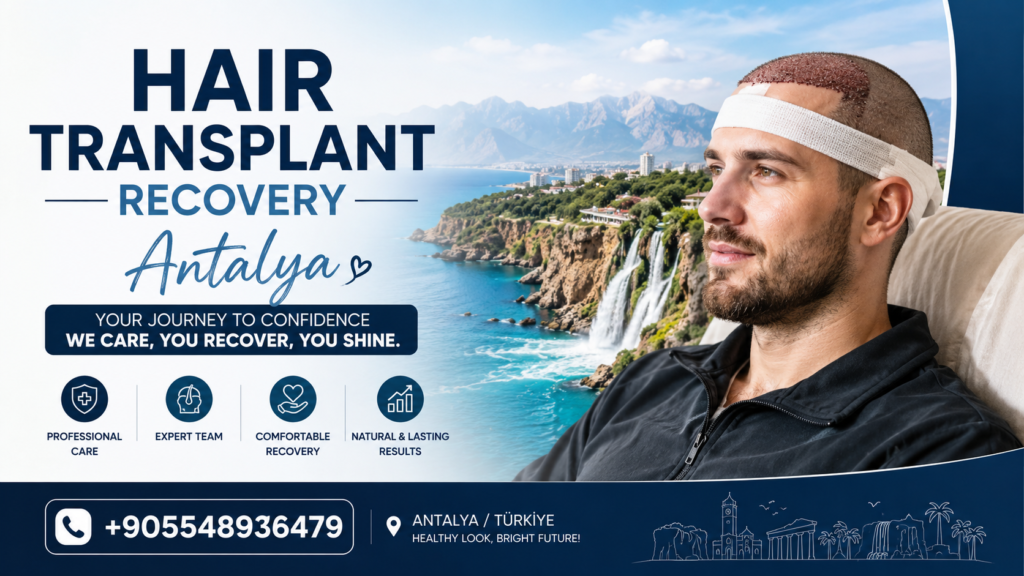
Immediately after your procedure, your scalp will be sensitive, and mild swelling around the forehead or eyes is common — this is a normal inflammatory response, not a complication. Most Antalya clinics schedule a control appointment the day after surgery to change the bandage, check the donor and recipient areas, and give you a gentle first wash under supervision.
During this period: Sleep with your head elevated on two pillows to reduce swelling. Avoid touching, scratching, or resting your head against anything. Avoid direct sun completely — Antalya’s coastal sun is stronger than most patients expect, even in shoulder-season months. Stay hydrated and avoid alcohol, which can worsen swelling.
DAYS 3 TO 7: SCABBING AND THE FIRST WASH CYCLE
Small scabs form around each graft as part of natural healing. Redness typically peaks around day 3 to 5 and begins to fade after that. Clinics usually provide a specific washing protocol using a lotion to soften scabs before rinsing them away with a gentle, non-direct water flow.
Do not pick at scabs — this can dislodge grafts that haven’t anchored yet. Light daily activities like walking around your hotel or resort are fine, but strenuous activity, bending over, or heavy lifting should wait.
DAYS 8 TO 14: SCABS CLEAR, TRAVEL HOME
By day 10 to 14, most scabs have fallen away naturally through continued washing, and the scalp looks noticeably calmer. This is generally the point at which patients fly home. If you’re flying from the UK, Germany, or elsewhere in Europe, aim to schedule your return for day 10 or later — airport dust, headrests, and long-haul dry cabin air are easier to manage once the scabs are gone.
A loose, soft cap (never anything tight, like a helmet or fitted baseball cap) can usually be worn from around day 10 onward if you need extra protection during travel.
WEEKS 2 TO 4: SHOCK LOSS
Around two to four weeks post-procedure, many patients notice the transplanted hairs beginning to shed. This is called shock loss, and it is completely normal — it does not mean the transplant has failed. The hair follicle itself remains intact beneath the skin and will begin producing new hair in the coming months.
This stage is often the most emotionally difficult part of recovery simply because it looks like a step backward. It isn’t. Almost every successful hair transplant patient passes through this phase.
MONTH 1: BACK TO NORMAL LIFE, WITH CAUTION ON SUN AND WATER
By the one-month mark, most patients can resume gentle exercise, including light swimming, though chlorinated pools and the salt in the Mediterranean can still irritate a healing scalp — many clinics recommend waiting until week 4 to 6 before full sea or pool immersion, and continuing to avoid direct midday sun on the scalp for at least two to three months. If you’re recovering during Antalya’s peak summer heat, a wide-brimmed hat (not tight-fitting) and high-SPF scalp sunscreen become essential once your clinic clears you to use them.
MONTHS 2 TO 3: THE QUIET PHASE
This period can feel uneventful. Shedding has mostly finished, but new growth hasn’t visibly started yet. Patients often describe this as the hardest stretch mentally, simply because nothing seems to be happening on the surface — while underneath, follicles are stabilizing and preparing to enter the active growth phase.
MONTHS 3 TO 6: VISIBLE NEW GROWTH BEGINS
Fine, thin new hairs typically start emerging around month 3, gradually thickening through month 6. Density is still building at this stage, and hair may appear patchy or uneven — this evens out considerably over the following months as more follicles activate.
MONTHS 6 TO 12: DENSITY AND MATURATION
This is where most of the visible transformation happens. Hair continues to thicken, darken, and fill in through months 6 to 9, with the majority of patients reaching 80 to 90 percent of their final result by month 12. Crown-area grafts, due to thicker skin and different blood supply, often take a few months longer than hairline or mid-scalp grafts to fully mature.
MONTHS 12 TO 18: FINAL RESULTS
Full, final density and texture are typically reached between 12 and 18 months. At this stage, transplanted hair behaves like the rest of your natural hair — it can be cut, styled, and treated normally, with no special aftercare required.
WHAT’S NORMAL VS. WHAT NEEDS ATTENTION
Normal: mild swelling in week one, itching during scab formation, shedding between weeks 2 and 8, uneven early growth between months 3 and 5.
Contact your clinic if you notice: increasing pain after day 4, pus or a strong odor around the grafts, spreading redness beyond the treated area, or fever. Reputable Antalya clinics provide ongoing WhatsApp or online support for exactly this reason — you should never feel like you’re managing complications alone from another country.
WHY RECOVERING IN ANTALYA WORKS IN YOUR FAVOR
Beyond the procedure itself, Antalya’s climate and setting genuinely support a comfortable recovery once you’re past the sun-sensitive early days — mild off-season temperatures, calm resort environments, and easy access to quiet beaches and historic sites for gentle, low-strain sightseeing during the weeks you’re waiting for scabs to clear and swelling to settle.
FREQUENTLY ASKED QUESTIONS
HOW LONG IS HAIR TRANSPLANT RECOVERY IN ANTALYA? Initial healing takes 10 to 14 days. Full, final results take 12 to 18 months, with most visible density appearing by month 9 to 12.
WHEN CAN I FLY HOME AFTER MY PROCEDURE IN ANTALYA? Most patients fly home around day 10 to 14, once scabs have mostly cleared through the recommended washing protocol.
IS SHEDDING NORMAL AFTER A HAIR TRANSPLANT? Yes. Shock loss between weeks 2 and 4 is expected and does not affect the long-term result.
WHEN CAN I SWIM IN THE SEA AFTER A HAIR TRANSPLANT IN ANTALYA? Most clinics recommend waiting at least 4 to 6 weeks before full sea or pool immersion, to avoid irritating the healing scalp.
CAN I WEAR A HAT DURING RECOVERY? A loose, soft cap is usually fine from around day 10. Tight-fitting hats or helmets should be avoided for at least 4 weeks.
WHEN WILL I SEE NEW HAIR GROWTH? Fine new hairs typically begin appearing around month 3, with noticeable thickening by month 6.
DOES CROWN AREA RECOVERY TAKE LONGER? Yes. Due to thicker skin and different blood supply, crown grafts can take up to 18 months to fully mature, longer than hairline grafts.
WHAT SHOULD I AVOID IN THE FIRST TWO WEEKS? Direct sun, strenuous exercise, alcohol, smoking, tight headwear, and touching or scratching the scalp.

YOUR COMPLETE DAY-BY-DAY HEALING TIMELINE +905548936479
Recovery is the part of your hair transplant journey that determines your final result, not just the surgery itself. Understanding what to expect at each stage — from the first 48 hours through to full density at 12 to 18 months — makes the process far less stressful and helps you plan your travel, work leave, and aftercare with confidence. If you’re preparing for a procedure in Antalya, our team is available to guide you through every stage of recovery, from your first post-op check to your final result.