
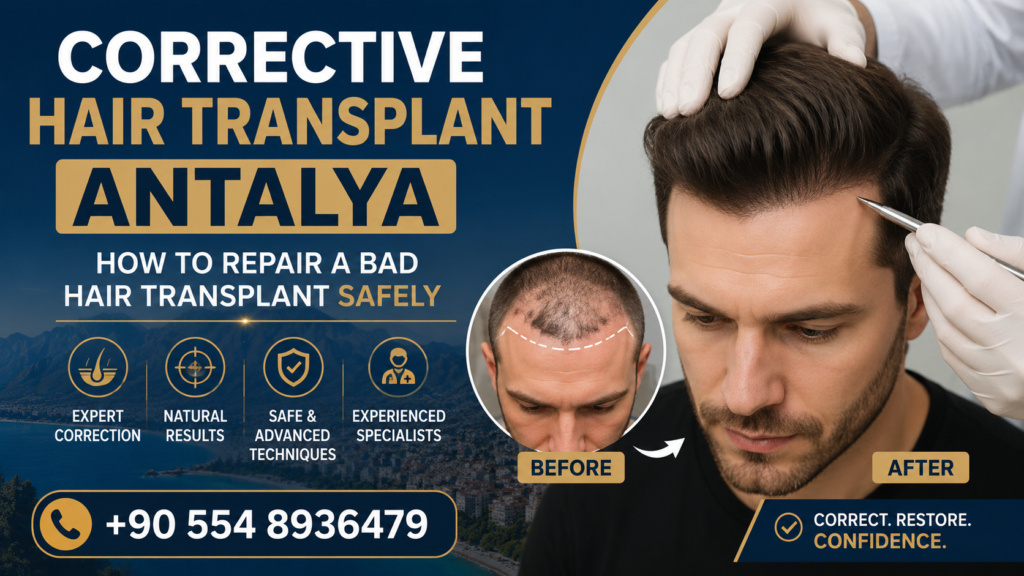
CORRECTIVE HAIR TRANSPLANT ANTALYA: HOW TO REPAIR A BAD HAIR TRANSPLANT SAFELY +90 554 8936479
A hair transplant is supposed to end the anxiety of hair loss, not create a new one. Yet every year, thousands of men and women are left with unnatural hairlines, patchy density, visible scarring, or a donor area that was harvested too aggressively by a clinic that prioritized speed over skill. If this describes your situation, you are not alone, and your case is very likely fixable. Corrective hair transplant Antalya procedures are specifically designed to repair the damage caused by a poorly planned or poorly executed first surgery, restoring both your appearance and your confidence.
Antalya has become one of Turkey’s leading destinations for this exact kind of revision work. Surgeons here regularly treat international patients arriving from the UK, Germany, the Nordic countries, and North America who underwent a rushed, technician-led procedure elsewhere and now need an experienced medical team to undo the damage. Choosing corrective hair transplant Antalya care means working with specialists who understand that repair surgery is fundamentally different, and considerably more delicate, than a first-time procedure.
WHY BAD HAIR TRANSPLANTS HAPPEN
Most failed results are not caused by hair transplantation itself, but by how and where it was performed. Common root causes include:
- Non-medical staff performing extraction or implantation instead of a qualified surgeon
- Overharvesting the donor area in a single aggressive session to maximize graft count
- Poor hairline design that ignores facial structure, age, and future hair loss patterns
- Low-quality FUT strip scars left wide, raised, or poorly closed
- Incorrect graft angulation, producing a “doll’s hair” or unnatural look
- Rushed sessions handling too many patients in one day, reducing precision
Recognizing the cause of your original problem helps your corrective hair transplant Antalya surgeon build the right revision plan from day one.
WHAT CORRECTIVE HAIR TRANSPLANT ANTALYA CAN FIX
TABLE: COMMON PROBLEMS AND CORRECTIVE SOLUTIONS
Problem: Unnatural, straight “pluggy” hairline
Corrective Solution: Softening with irregular, single-hair grafts placed at natural angles
Problem: Overharvested or patchy donor area
Corrective Solution: Strategic redistribution of remaining follicles, sometimes combined with scalp micropigmentation
Problem: Visible linear FUT scarring
Corrective Solution: FUE scar camouflage grafting directly into scar tissue
Problem: Low density or thin coverage
Corrective Solution: Additional Sapphire FUE or DHI sessions to increase graft count safely
Problem: Uneven or asymmetrical hairline
Corrective Solution: Redesigned hairline mapped to facial symmetry and hair direction
Problem: Shock loss or poor graft survival
Corrective Solution: Staged repair sessions allowing full healing between procedures
THE CORRECTIVE PATIENT JOURNEY
- Remote Assessment: You send photos and your surgical history via WhatsApp for an initial evaluation.
- Donor Audit: On arrival, the surgeon examines exactly how much healthy donor hair remains and where it can safely be harvested.
- Revision Planning: A tailored plan is built around your specific problem, whether that is scarring, density, or hairline shape.
- Staged or Single-Session Surgery: Depending on complexity, corrective work may be completed in one visit or split across staged sessions to protect a limited donor supply.
- Extended Aftercare: Revision patients typically receive closer follow-up, since healed scalp tissue and prior scarring behave differently than untouched skin.
EXPERT TIP: Repair cases almost always require more precise graft placement than first-time surgery because the surgeon is working with less donor hair and pre-existing scar tissue. Ask any clinic directly how many corrective cases they perform per month, not just how many first-time transplants they perform.
COST FACTORS FOR CORRECTIVE HAIR TRANSPLANT ANTALYA
Revision surgery is priced differently from a standard procedure because it demands more surgical time, more precision, and often a second visit. Costs are generally influenced by:
- The amount of healthy donor hair still available
- Whether scalp micropigmentation is needed alongside grafting
- The number of previous procedures and scar tissue involved
- Whether the repair can be completed in one session or requires staging
- The technique used: Sapphire FUE, DHI, or a combined approach
Because repair work is more complex, it typically costs more per graft than a first-time transplant. Reputable corrective hair transplant Antalya clinics will always provide a written, itemized quote after reviewing your case rather than a flat, generic price.
RISKS AND SAFETY CONSIDERATIONS
Corrective procedures carry the same general risks as any hair transplant: temporary swelling, redness, numbness, or the rare possibility of infection. What makes revision surgery riskier if handled poorly is the limited donor supply. If a second clinic overharvests an already-depleted donor area, there may be no hair left for future correction. This is why experience specifically in repair cases matters more than general transplant volume when you are choosing where to have corrective work done. A qualified surgeon will always tell you honestly if your donor area cannot support the density you are hoping for, rather than promising an unrealistic result to close the sale.
AFTERCARE FOR REVISION PATIENTS
- Follow the same washing protocol as a first-time transplant, but be extra gentle around previously scarred tissue
- Avoid direct sun exposure on both the donor and recipient areas for at least four weeks
- Attend every scheduled follow-up, since healing patterns in revised areas can differ from fresh tissue
- Expect a longer settling period before final results are visible, often 12 to 15 months for complex repairs
- Report any unusual pulling, tightness, or discoloration immediately to your surgical team
TRUST SIGNALS TO LOOK FOR
Before committing to any clinic for corrective hair transplant Antalya treatment, confirm the following:
- The surgeon personally performs or directly supervises extraction and implantation
- The clinic is licensed under Turkish Ministry of Health regulations
- Before-and-after cases specifically showing repair work, not only first-time results
- Transparent, written pricing with no hidden add-on fees
- A realistic conversation about donor limitations rather than guaranteed density promises
READY TO REPAIR YOUR HAIR TRANSPLANT RESULTS?
If your first procedure left you with an unnatural hairline, visible scarring, or a depleted donor area, you do not have to live with the outcome. Send your photos for a free, confidential online consultation and receive a personalized corrective hair transplant Antalya plan built around exactly what your donor area can safely support. Contact our team via WhatsApp today and take the first step toward a natural, undetectable result.
FREQUENTLY ASKED QUESTIONS
CAN A BAD HAIR TRANSPLANT ALWAYS BE FIXED?
Most cases can be significantly improved, though the extent of correction depends on how much healthy donor hair remains. A thorough evaluation before travel helps set realistic expectations.
HOW LONG DO I HAVE TO WAIT BEFORE A CORRECTIVE PROCEDURE?
Surgeons generally recommend waiting at least 12 months after the original transplant so the scalp fully heals and true results become visible before planning revision work.
IS CORRECTIVE HAIR TRANSPLANT ANTALYA MORE EXPENSIVE THAN A FIRST-TIME PROCEDURE?
Typically yes, because repair work requires more precision, more planning, and sometimes staged sessions. Clinics should always confirm pricing after reviewing your specific case.
WHAT IF MY DONOR AREA WAS OVERHARVESTED?
Surgeons may use scalp micropigmentation alongside limited grafting to create the appearance of density without further depleting a fragile donor zone.
CAN SCARRING FROM A STRIP (FUT) PROCEDURE BE FIXED?
Yes, FUE grafts can often be placed directly into scar tissue to camouflage the line, though results depend on scar width and skin quality.
WILL I NEED MORE THAN ONE CORRECTIVE SESSION?
Complex cases involving significant scarring or overharvesting are sometimes staged across two sessions to protect the remaining donor supply and allow proper healing.
IS IT SAFE TO TRAVEL TO ANTALYA FOR REPAIR SURGERY?
Yes, provided the clinic is licensed, the surgeon has direct experience with revision cases, and you receive a written treatment plan before booking travel.
HOW DO I KNOW IF MY ORIGINAL CLINIC DID POOR WORK?
Warning signs include an unnaturally straight hairline, visible plugs, thin or bald patches in the donor zone, and wide or raised scarring at the extraction site.
WHAT TECHNIQUE IS BEST FOR CORRECTIVE WORK?
There is no single answer. Sapphire FUE, DHI, or a combination is chosen based on your donor supply, scar type, and the specific problem being corrected.
DOES CORRECTIVE SURGERY GUARANTEE PERFECT RESULTS?
No responsible surgeon guarantees perfection, but experienced revision specialists can dramatically improve density, symmetry, and naturalness in the vast majority of cases.